
Philippines staffing research ·
Who should own flaky tests in an outsourced QA engagement?
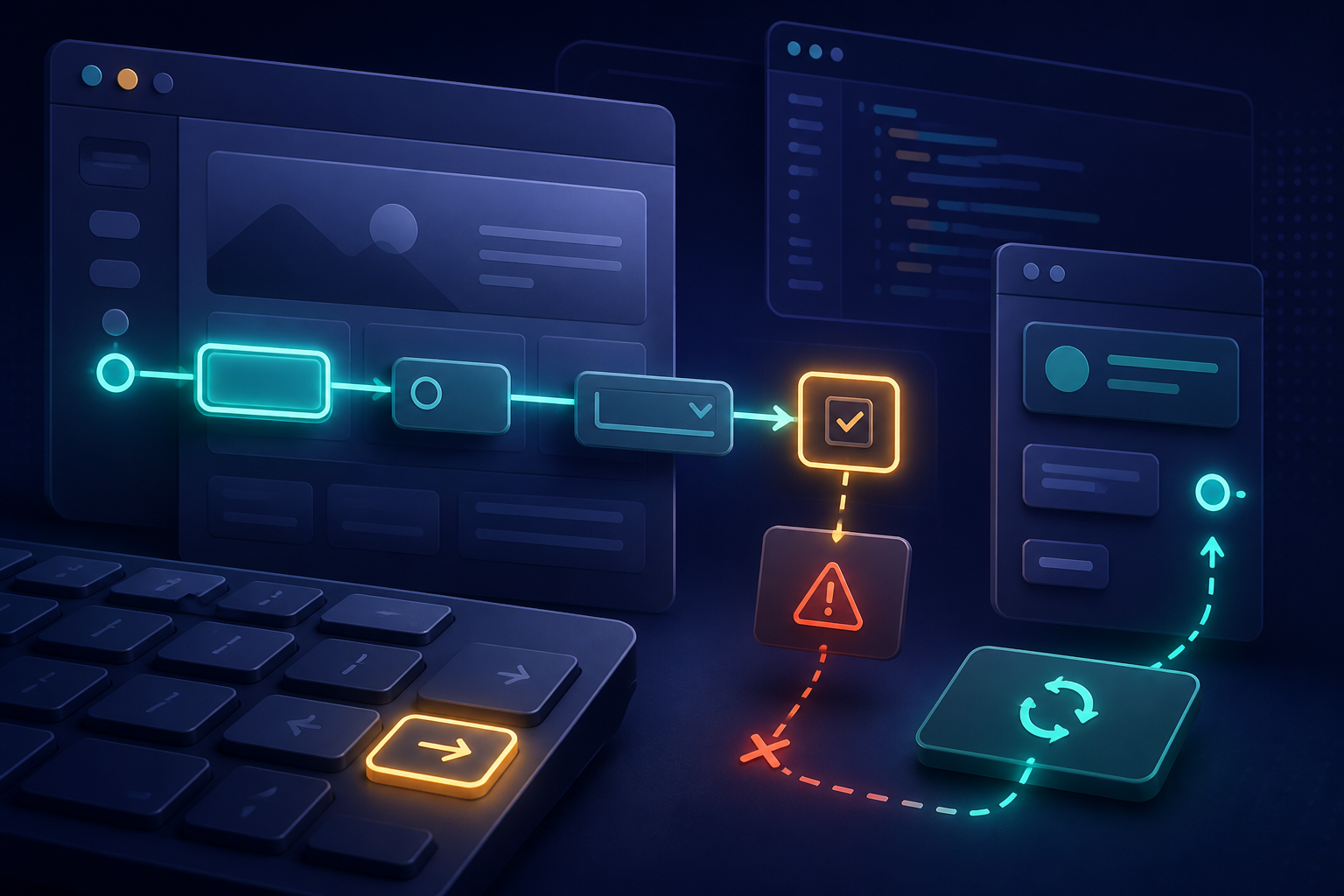
A containment and repair model that keeps retries from hiding risk or making QA own every system defect.
A flaky test produces inconsistent outcomes without a relevant system change. The cause may be product, test, data, environment, dependency, runner, or expectation. Assigning every intermittent failure to outsourced QA is a category error. Ownership follows the evidence needed to remove uncertainty: QA can reproduce, classify, contain, and improve automation, while developers, platform owners, or service owners repair causes in their systems. The release owner decides whether risk permits a temporary exception.
Methodology: define a failure taxonomy, preserve the first occurrence, vary one condition at a time, and route the defect to the demonstrated boundary. Playwright documents artifacts and retries; Google and pytest provide established flaky-test approaches. This routing model is analysis, not a standard they mandate. No client run history was available, so no failure-rate or savings claim is made. Sources were checked October 2, 2026.
Preserve before rerunning. Save test and application revisions, runner image, browser versions, seed, workers, shard, locale, timezone, flags, synthetic account, network conditions, trace, video, screenshot, console, server logs, and timestamps. Sanitize secrets and personal data. A later pass does not erase the failure. If retries are automatic, report the initial attempt and retry disposition separately so the decision sees both instability and eventual outcome.
Classify with controlled experiments. A locator may fail under concurrency; shared data may collide across shards; an application race may reproduce manually; an external sandbox may throttle. Vary worker count, order, seed, browser, network, dataset, clock, and dependency mode one at a time, then restore the suspected condition. Calling a failure environmental without evidence simply transfers responsibility to an unnamed owner.
Containment protects signal. Move the test to a visible non-blocking lane, reduce concurrency, replace an unreliable dependency with an approved contract fixture, or pin a version temporarily. Quarantine records test, signature, first occurrence, impact, owner, expiry, and exit criteria. Deleting the test or adding unlimited retries removes the warning. Preserve affected coverage through a stable lower-level check or named manual control where feasible.
Route by causal boundary. QA owns unstable selectors, leaked state, invalid waits, order coupling, and fixture cleanup. Feature teams own product races. Platform teams own controlled runner capacity, clock, container, browser distribution, and networking. External sandboxes may need an incident or stub. While cause is unknown, appoint an investigation owner. The release owner alone decides whether a required check may be waived.
Retries have a narrow diagnostic role. They can collect a trace and reveal variation, but cannot convert nondeterminism into a passing control. Track retry-only passes and set escalation. Tests with real side effects can duplicate data unless fixtures and idempotency are safe. Never aim an experimental suite at production customers, payments, messages, or irreversible workflows merely to estimate frequency.
Repair the demonstrated cause. Replace sleeps with bounded assertions on user-visible readiness or protocol events. Isolate data by worker. Freeze time only when product behavior permits it. Seed randomness. If the product races, add a regression failing before the application patch. After correction, repeat the original configuration and stress-oriented variations; one green run proves one outcome, not reliability.
Measure unique flaky tests, affected runs, initial failures, retry-only passes, quarantine age, recurrence, and blocked release minutes. Group identical signatures so one infrastructure event does not appear as hundreds of defects. Show oldest quarantines and expired exceptions. A lower rate after deleting difficult coverage is not improvement; a rise after enabling detection may be visibility.
The handoff includes smallest failing command, fixtures, artifacts, excluded factors, owner, containment, correction, verification runs, uncertainty, and deadline. A Philippines-based QA lane can send an asynchronous summary of new signatures, aged quarantines, owner responses, and release blockers. The company must provide safe environments and accountable feature owners, or QA becomes a reporting queue without resolution.
Separate language: a trace showing a disabled button after API success is fact. A missed state update is analysis needing experiment or code evidence. Higher frequency under load is inference until measured. Unknown runner saturation and unavailable logs are uncertainty. Intermittent failures invite confident stories based on the latest pass, so retain competing explanations until controlled evidence rules them out.
Limitations: repetitions estimate observed instability but cannot prove no recurrence. Fixtures may remove integration behavior, while sandboxes add uncontrolled variation. Frameworks evolve. Playwright, pytest, and Google do not assign contractual responsibility. Agreements should define response expectations, but technical ownership remains attached to systems and evidence rather than vendor labels.
Review the register in the release forum that can assign product and platform owners, fund repairs, and reject expired waivers before the next release candidate. Use a shared flaky-test register with investigation owner, causal owner, release owner, containment expiry, and repair evidence. Outsourced QA can own detection, artifacts, test-side corrections, and verification. It should not silently waive a failed control or accept every application defect. The company keeps risk acceptance and release authority, ensuring an intermittent failure remains visible until explained, repaired, replaced, or consciously retired.
An investigation matrix should begin with negative controls. Run an adjacent stable test under the same worker, browser, dataset, and network so a broad environment failure is not mistaken for one test's defect. Run the suspect behavior through a narrower API or component check to separate user-interface synchronization from server state. Repeat with a fresh identity and with the original failing identity if policy permits. If only one account fails, preserve its synthetic state before cleanup. If all tests on a runner fail, stop spending cycles on selector changes and route the incident to the platform boundary.
Statistical language needs care. Ten passes do not prove stability, and one failure does not estimate a population rate well. Record the number of attempts, configuration, and confidence limits only if the team has enough observations and a defined sampling scheme. Otherwise report the outcomes plainly. Repair verification should include the original seed and order, several alternative orders, supported browsers, and the concurrency that exposed the problem. Reopen a supposedly repaired item when the same signature returns; do not create a fresh ticket that hides recurrence. Before removing quarantine, ensure the test still fails when its protected behavior is deliberately broken in a safe fixture. This mutation-style check guards against a “repair” that merely weakened the assertion. The decision owner can then see whether the control regained sensitivity, whether residual nondeterminism remains, and which customer-relevant behavior would be unprotected if the test were retired.
Environment ownership deserves its own contract. Record who updates browser images, resets test tenants, maintains seed data, renews certificates, monitors sandbox quotas, and announces maintenance. Without those owners, QA may compensate for stale infrastructure inside tests until the suite becomes harder to understand. Use immutable runner versions for a diagnostic window, then test upgrades deliberately rather than allowing silent drift. For parallel suites, define namespaces for accounts, orders, files, queues, and email sinks so cleanup from one worker cannot erase another worker's evidence. Cleanup should be safe to repeat and restricted to the current synthetic namespace. If a run stops abruptly, a scheduled janitor can report and remove expired fixtures without masking the original failure. These controls turn “the environment was flaky” into specific observations: a certificate expired, a tenant exceeded quota, or two workers shared an identifier. Only then can the correct owner repair the boundary and QA verify the restored behavior.
Sources
Related Research
What observability evidence helps review an outsourced software release?
Which evidence shows an outsourced web change preserved keyboard access?
FAQ
What should happen first?
Begin with a bounded ticket, approved access, and a named reviewer.
Who approves production changes?
The company’s technical owner keeps final merge and release authority.