
Philippines staffing research ·
Which evidence shows an outsourced web change preserved keyboard access?
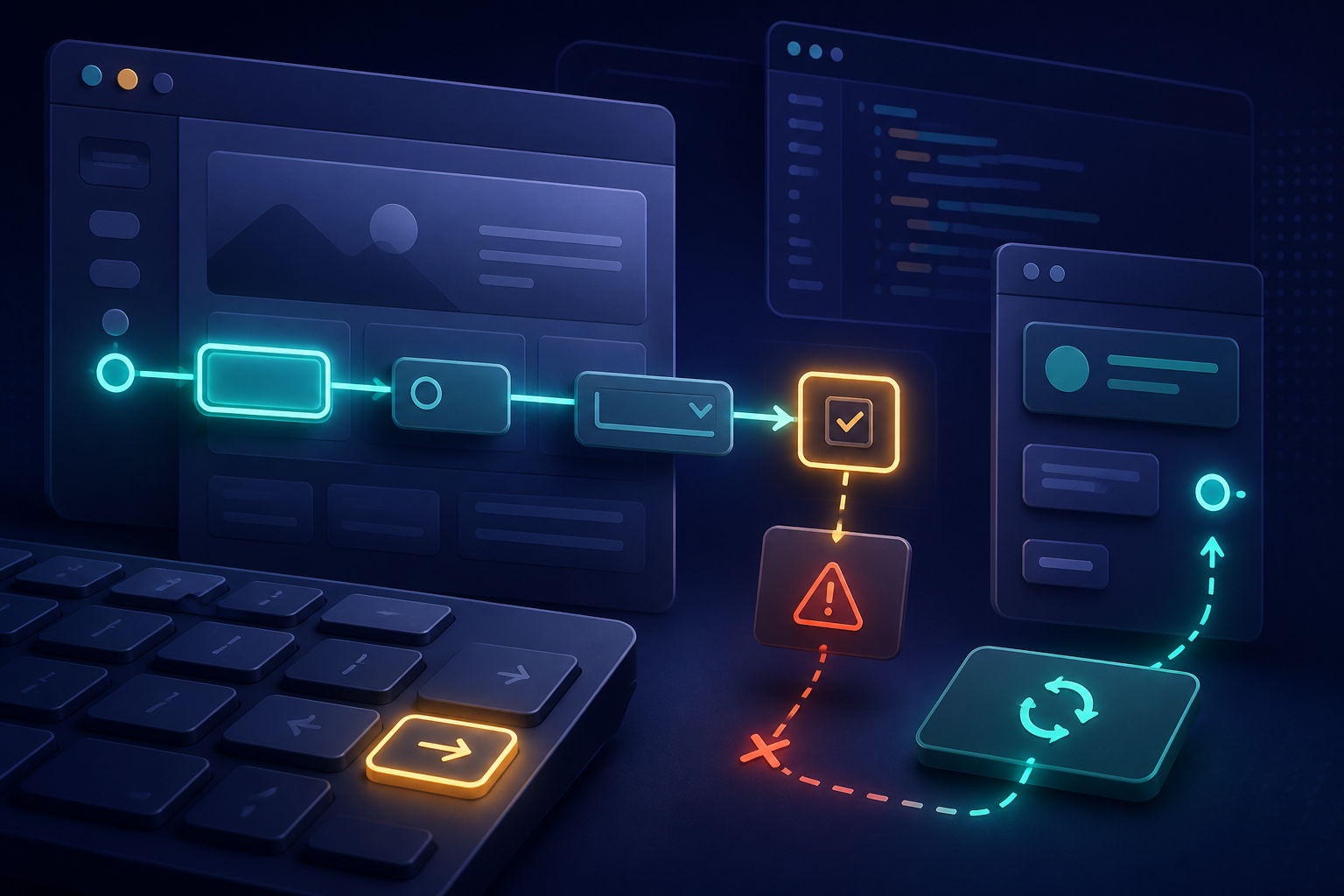
A research method for separating automated signals, focus behavior, semantics, and user-task evidence.
Research question: what evidence can show that a delegated web change preserves keyboard access for a defined user task? A green automated scan is not the same as a usable interaction. Keyboard access depends on focus order, visible focus, semantic controls, dialog behavior, error recovery, dynamic updates, and whether a person can complete the task without a pointer. This study asks how an outsourced programmer can prepare bounded evidence while the company retains responsibility for product decisions and conformance review.
Define one route and one task before testing. Examples include opening a menu, filtering a list, submitting a form with an error, editing a record, or completing a checkout-like flow in a safe fixture. Name the starting focus, expected landmarks, interactive controls, state changes, and completion signal. The test should include a realistic path and a recovery path. A page can pass a static rule while trapping focus in a dialog or losing the user after validation fails.
WCAG 2.2 provides success criteria and conformance structure; WAI-ARIA describes semantics and states for interactive widgets; MDN explains practical keyboard-accessible behavior; NIST SSDF contributes a controlled verification lens. The sources are claim-relevant guidance, not an audit certificate. They support a repeatable observation protocol. They do not prove that every assistive technology, browser, language, input method, or user journey behaves identically.
Use a layered method. First inspect the rendered semantics and document landmarks, headings, labels, names, roles, states, and relationships. Next perform the task with the keyboard alone, recording every focus movement and visible indicator. Then test dynamic states such as an expanded menu, a modal, an inline error, a loading result, and a newly inserted item. Finally compare the expected task outcome with the observed page state. Each layer catches a different class of regression.
Focus order should be recorded as a sequence, not a vague impression. Note where focus begins, which control receives it after activation, whether the order follows the visual and task order, and whether focus becomes invisible or stranded. For a dialog, test entry, internal navigation, escape behavior, close-button access, and return to the invoking control. For a menu or combobox, state whether the implementation follows its declared interaction model rather than assuming that a role attribute creates behavior.
Error handling deserves its own evidence. Submit incomplete or invalid synthetic data, move through the fields with the keyboard, and observe whether the error is associated with the field, announced or otherwise discoverable, and recoverable without restarting the entire task. Test a server-side response as well as a client-side validation path where the product uses both. The programmer can reproduce a defect and propose a narrow fix; the owner decides copy, policy, and release priority.
Automated tools are useful for finding missing labels, contrast risks, duplicate IDs, and structural anomalies, but they should be treated as one evidence layer. Record tool name and version, route state, fixture, and findings. Do not convert a tool pass into a claim of accessibility conformance. Conversely, a tool warning should be interpreted against the actual user task rather than blindly suppressed. Facts describe the observed rule or behavior; analysis explains its likely impact and confidence.
Outsourced work needs a safe access boundary. The programmer may use a local or preview build, synthetic records, approved browser tooling, and a defined route. They should not request production customer data or announce a conformance claim without the owner's review. If the route depends on authentication, provide a least-privilege test identity with disposable content. Security, privacy, legal, and release decisions remain outside the coding task.
A useful sample compares the changed route with a prior approved behavior where available. Record the source revision, browser and viewport, operating-system input method, fixture state, task steps, expected focus, observed focus, and screenshots only when they clarify a state. Repeat the critical path after the fix and include an untouched control route to identify environment-wide changes. One successful pass is evidence for that path, not for every route in the application.
Limitations include unavailable screen readers, incomplete browser coverage, dynamic third-party widgets, localized content, responsive layouts, and the difference between technical observation and lived user experience. WCAG mapping can also require judgment about context and conformance scope. State what was not tested and route unresolved issues to an appropriate accessibility or product reviewer. Do not use a limited keyboard exercise to imply legal compliance or universal usability.
The conclusion is narrow: preserved keyboard access is better supported by a task-specific sequence of semantic inspection, keyboard interaction, dynamic-state checks, error recovery, and bounded repetition than by an automated score alone. Outsourced programmers can produce this evidence and a focused correction while the company decides product priorities, conformance interpretation, and release acceptance. The record is strongest when it names the exact path that passed and the paths that remain unknown.
This is bounded research for teams working with outsourced programmers. It does not certify a product, establish a universal benchmark, or replace legal, privacy, security, accessibility, or release review. An authorized company technical owner retains control of production access, merges, releases, customer data, and residual risk.
Keep the exact task sequence and changed content available for a focused retest. One additional condition at a time can show whether the finding belongs to a component, a content shape, or a broader interaction pattern. That makes the evidence easier to review than a broad claim about the whole site.
A focused retest should preserve the same route and task while changing only one condition. This helps the reviewer decide whether the finding belongs to component behavior, content shape, or the wider interaction model.
The evidence should name the browser, viewport, input method, route state, and fixture revision. If one of those conditions was unavailable, record it as an explicit limitation rather than silently broadening the meaning of a passing observation. That keeps the accessibility result useful for the owner who must choose the next review.
Sources
Related Research
FAQ
What should happen first?
Begin with a bounded ticket, approved access, and a named reviewer.
Who approves production changes?
The company’s technical owner keeps final merge and release authority.