
Developer staffing guide · 9 minute read ·
Outsource application configuration-drift review with source evidence
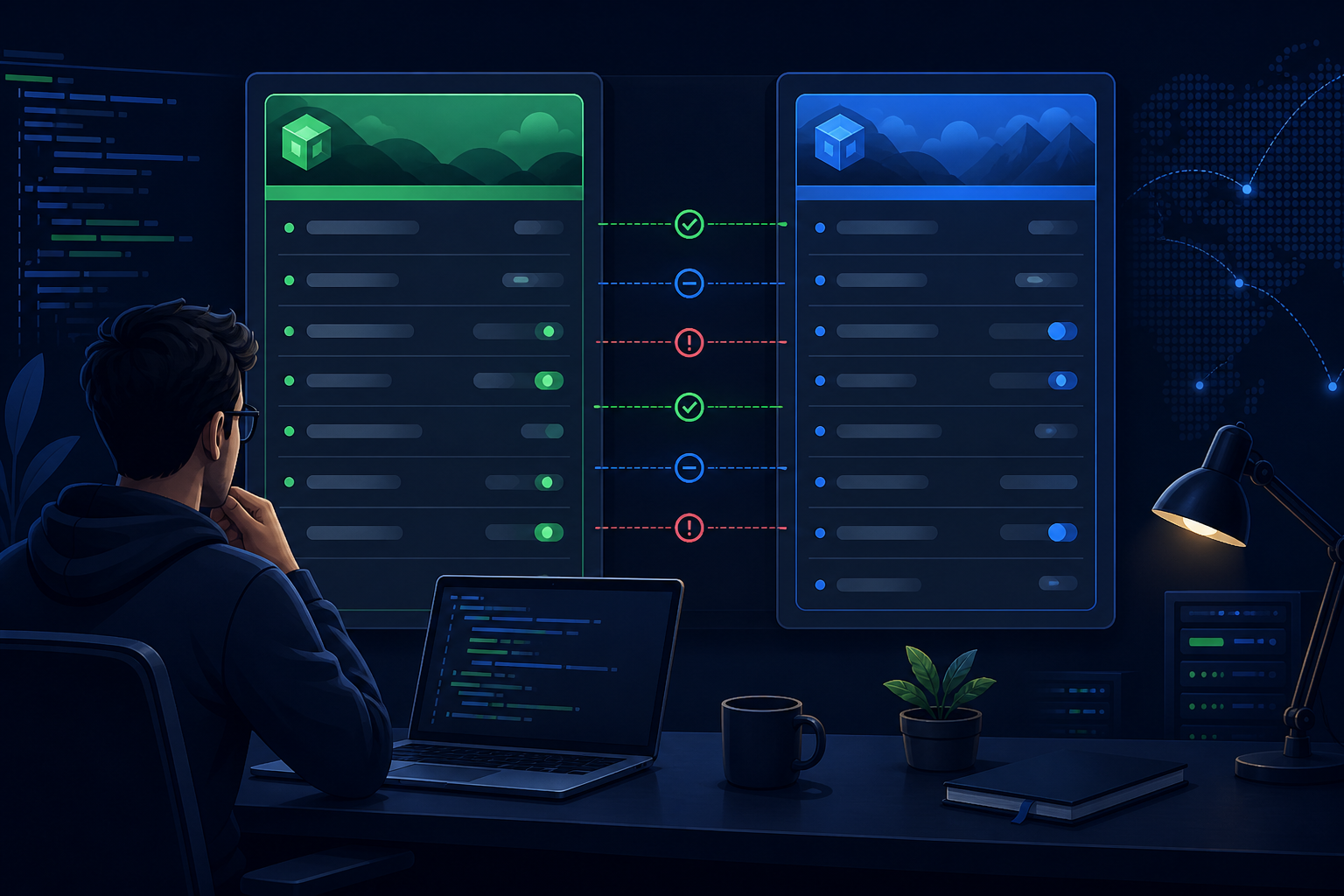
Compare approved configuration, runtime assumptions, and environment behavior without exposing secrets or changing production settings.
Readiness check
Is the handoff ready?
Use this table before you send the first ticket. Fix the weak spots while access is still limited.
| Area | Ready | Needs work |
|---|---|---|
| Scope | One named behavior with acceptance rules | A broad improvement request |
| Evidence | Safe fixture and observed result | An unverified success claim |
| Access | Task-limited approved access | Shared credentials or live data |
| Review | Named owner accepts the next action | Unreviewed policy or release change |
Define the configuration contract
Configuration drift is a behavior problem when two environments interpret the same application differently. Start with the route, job, or integration that matters and list the keys, defaults, allowed values, and owner for each. Include whether a missing key should block startup, disable a feature, or use a documented fallback.
The programmer can compare approved source and an authorized test environment. They should not request broad secret access or infer a production value from an error message. The owner supplies the contract and decides which differences are intentional.
Use safe fingerprints
Compare presence, type, length, and approved fingerprints rather than copying secret values into the evidence. For URLs, record host category and route shape where safe. For feature settings, record the effective non-sensitive value and its source.
A redacted report must still let a reviewer distinguish missing, malformed, and mismatched configuration. If it cannot, ask the owner for a safer comparison method rather than weakening the boundary.
Compare startup and runtime
A service can start with a default and fail later when a route or worker first uses a missing key. Exercise startup, one primary route, one failure path, and one background action in the approved environment. Record where the difference becomes observable.
Do not call a successful health endpoint proof that every dependency is configured. The test should identify the actual application behavior and any hidden fallback.
Classify intentional differences
Development, preview, and production often need different hosts, logging levels, or feature values. Mark each difference as expected, undocumented, or suspicious based on the approved contract. Do not normalize environments merely to make a textual diff empty.
The owner decides whether an environment difference is policy, temporary setup, or drift requiring correction. The programmer can update documentation or add a configuration check once that decision is made.
Review defaults and fail-safe behavior
Exercise blank, malformed, expired, and unavailable settings in a sandbox when the application supports them. Confirm that a safe default does not silently widen access, send data externally, or change a destructive operation into an automatic action.
Keep external integrations stubbed and use synthetic accounts. If a fallback would have customer impact, stop at the observation and escalate the policy question.
Inspect source and generated config
Trace each effective setting to its source file, environment binding, generated artifact, or runtime secret manager reference. Separate repository changes from deployment-owned settings so a reviewer can see what this task actually controls.
Do not edit a deployment system, secret store, or production environment as part of the review. If the source of truth is outside the repository, record the owner and requested evidence.
Make drift repair reversible
For a confirmed repository-side mismatch, propose the smallest change, affected environments, validation command, and rollback. Avoid bundling formatting or unrelated environment cleanup. A configuration correction should be easy to review and easy to revert.
If a correction requires secret rotation or a release action, hand it to the owner. The programmer can prepare source and test changes but cannot claim the runtime is repaired without authorized evidence.
Return a redacted drift report
The handoff should list key meaning, source, environment observation, classification, safe fingerprint, test path, and owner decision needed. State which values were intentionally not collected and why.
This makes configuration review useful without turning an outsourced task into credential handling. The owner retains secret, infrastructure, release, and incident authority.
Explain drift without exposing secrets
Each drift row should explain setting meaning, approved source, safe runtime observation, classification, and owner action. Presence, type, length, host category, and approved fingerprints can distinguish missing or malformed bindings without copying secret values. Exercise startup and the first route or worker that consumes the setting; a health endpoint alone does not prove runtime readiness.
Identify defaults that could widen access, send data externally, or disable a safety control. Separate repository-owned configuration from deployment-owned bindings and secret references. The programmer can add a validation check or documentation correction, but should not rotate secrets, edit production settings, or normalize intentional differences.
Compare effective behavior with ownership
For each drift row, connect the approved meaning, source, safe fingerprint, effective value, consuming route or worker, and environment intent. Mark the first disagreement and classify it as missing, malformed, delayed, intentional, or unresolved. A textual diff is not enough when defaults or secret references change runtime behavior. Preserve the exact observation and the condition not tested, then stop before editing deployment settings or rotating credentials. This gives a reviewer a reproducible configuration decision without turning the article into an instruction to access production secrets.
The programmer can prepare a validation check or documentation correction; the company owner retains secret, infrastructure, release, and incident authority.
Keep the evidence bounded
For configuration drift review, preserve the boundary between observation and approval. Record the fixture, expected result, observed result, environment, and exact condition that was not tested. Compare source behavior with the user-visible result and identify the first layer where they disagree. Keep synthetic identities, safe values, and task-limited access in every example. A reviewer should be able to repeat the smallest case without access to live customer records, credentials, or operational controls. If the evidence points to a product, security, schema, or release decision, stop at that boundary and name the owner rather than silently choosing a policy.
The final route record should state what the review proves, what it only suggests, and what remains open. An outsourced programmer can prepare a focused test, source correction, or reproducible handoff when the expected behavior is known. The company retains authority over production changes, customer impact, access exceptions, retention, release timing, and any claim broader than the tested fixture. This separation makes the article practical for software teams while keeping its guidance factually bounded.
Classify drift by behavior and ownership
For a configuration drift review, record approved meaning, source, type, fingerprint, effective value, consuming route, and environment intent against the approved fixture before drawing a conclusion. Compare the expected rule with the observed result at each layer and name the first disagreement. Keep accepted, rejected, delayed, missing, and permission-sensitive cases separate when the route supports them. A passing status or matching count is not enough if the user-visible state, stored identity, or recovery action is wrong.
The handoff should state the environment, safe fixture, exact observation, untested condition, and smallest reproducible next step. The outsourced programmer can prepare a focused test or source correction; the company owner retains policy, production access, release timing, and any customer-impact decision.
Turn the review into a repeatable operating record
Configuration drift is a behavior problem when two environments interpret the same application differently. Start with the route, job, or integration that matters and list the keys, defaults, allowed values, and owner for each. Include whether a missing key should block startup, disable a feature, or use a documented fallback. The programmer can compare approved source and an authorized test environment. They should not request broad secret access or infer a production value from an error message. The owner supplies the contract and decides which differences are intentional. Compare presence, type, length, and approved fingerprints rather than copying secret values into the evidence. For URLs, record host category and route shape where safe. For feature settings, record the effective non-sensitive value and its source. A redacted report must still let a reviewer distinguish missing, malformed, and mismatched configuration. If it cannot, ask the owner for a safer comparison method rather than weakening the boundary. A service can start with a default and fail later when a route or worker first uses a missing key. Exercise startup, one primary route, one failure path, and one background action in the approved environment. Record where the difference becomes observable. Do not call a successful health endpoint proof that every dependency is configured. The test should identify the actual application behavior and any hidden fallback. Development, preview, and production often need different hosts, logging levels, or feature values. Mark each difference as expected, undocumented, or suspicious based on the approved contract. Do not normalize environments merely to make a textual diff empty. The owner decides whether an environment difference is policy, temporary setup, or drift requiring correction. The programmer can update documentation or add a configuration check once that decision is made.
Exercise blank, malformed, expired, and unavailable settings in a sandbox when the application supports them. Confirm that a safe default does not silently widen access, send data externally, or change a destructive operation into an automatic action. Keep external integrations stubbed and use synthetic accounts. If a fallback would have customer impact, stop at the observation and escalate the policy question. Trace each effective setting to its source file, environment binding, generated artifact, or runtime secret manager reference. Separate repository changes from deployment-owned settings so a reviewer can see what this task actually controls. Do not edit a deployment system, secret store, or production environment as part of the review. If the source of truth is outside the repository, record the owner and requested evidence. For a confirmed repository-side mismatch, propose the smallest change, affected environments, validation command, and rollback. Avoid bundling formatting or unrelated environment cleanup. A configuration correction should be easy to review and easy to revert. If a correction requires secret rotation or a release action, hand it to the owner. The programmer can prepare source and test changes but cannot claim the runtime is repaired without authorized evidence. The handoff should list key meaning, source, environment observation, classification, safe fingerprint, test path, and owner decision needed. State which values were intentionally not collected and why. This makes configuration review useful without turning an outsourced task into credential handling. The owner retains secret, infrastructure, release, and incident authority. Each drift row should explain setting meaning, approved source, safe runtime observation, classification, and owner action. Presence, type, length, host category, and approved fingerprints can distinguish missing or malformed bindings without copying secret values. Exercise startup and the first route or worker that consumes the setting; a health endpoint alone does not prove runtime readiness. Identify defaults that could widen access, send data externally, or disable a safety control. Separate repository-owned configuration from deployment-owned bindings and secret references. The programmer can add a validation check or documentation correction, but should not rotate secrets, edit production settings, or normalize intentional differences. For each drift row, connect the approved meaning, source, safe fingerprint, effective value, consuming route or worker, and environment intent. Mark the first disagreement and classify it as missing, malformed, delayed, intentional, or unresolved. A textual diff is not enough when defaults or secret references change runtime behavior. Preserve the exact observation and the condition not tested, then stop before editing deployment settings or rotating credentials. This gives a reviewer a reproducible configuration decision without turning the article into an instruction to access production secrets. The programmer can prepare a validation check or documentation correction; the company owner retains secret, infrastructure, release, and incident authority. For configuration drift review, preserve the boundary between observation and approval. Record the fixture, expected result, observed result, environment, and exact condition that was not tested. Compare source behavior with the user-visible result and identify the first layer where they disagree. Keep synthetic identities, safe values, and task-limited access in every example. A reviewer should be able to repeat the smallest case without access to live customer records, credentials, or operational controls. If the evidence points to a product, security, schema, or release decision, stop at that boundary and name the owner rather than silently choosing a policy. The final route record should state what the review proves, what it only suggests, and what remains open. An outsourced programmer can prepare a focused test, source correction, or reproducible handoff when the expected behavior is known. The company retains authority over production changes, customer impact, access exceptions, retention, release timing, and any claim broader than the tested fixture. This separation makes the article practical for software teams while keeping its guidance factually bounded. For a configuration drift review, record approved meaning, source, type, fingerprint, effective value, consuming route, and environment intent against the approved fixture before drawing a conclusion. Compare the expected rule with the observed result at each layer and name the first disagreement. Keep accepted, rejected, delayed, missing, and permission-sensitive cases separate when the route supports them. A passing status or matching count is not enough if the user-visible state, stored identity, or recovery action is wrong. The handoff should state the environment, safe fixture, exact observation, untested condition, and smallest reproducible next step. The outsourced programmer can prepare a focused test or source correction; the company owner retains policy, production access, release timing, and any customer-impact decision.
Copy-ready brief
Paste this into your hiring request
Configuration drift is a behavior problem when two environments interpret the same application differently. Start with the route, job, or integration that matters and list the keys, defaults, allowed values, and owner for each. Include whether a missing key should block startup, disable a feature, or use a documented fallback.
Fixture, expected result, observed result, and open gap.
Use named access and synthetic or masked data.
The company decides policy, exceptions, merge, and release.
Buyer questions
Questions about planning the role
What should the first task prove?
Configuration drift is a behavior problem when two environments interpret the same application differently. Start with the route, job, or integration that matters and list the keys, defaults, allowed values, and owner for each. Include whether a missing key should block startup, disable a feature, or use a documented fallback.
What belongs in the evidence?
Show the fixture, expected result, observed result, and any untested condition.
Who decides the exception?
A named company owner retains product, access, policy, merge, and release decisions.
Sources
Planning references
These links explain the security, code review, and worker classification points used in this guide.
- NIST Secure Software Development FrameworkReference for bounded software development risk controls.
- Google Technical WritingReference for clear, reviewable technical explanations.